

Welcome To ICOBAR 2026
We are at the dawn of a mobility revolution. The intensive digitization of transportation, powered by AI, IoT, and autonomous systems, is not only changing how we move. It is reshaping economies, redefining urban landscapes, and setting new benchmarks for sustainability and inclusivity.
But this transformation demands more than technological brilliance. It requires an equally bold evolution in governance, business strategy, and policy so that innovation can be adopted responsibly, scaled effectively, and deliver real outcomes for people and the planet.
Building on this imperative, ICOBAR 2026 is launched in synergy with SMART 2026, creating a convergent platform where smart mobility meets administrative innovation and agile business models. ICOBAR-SMART 2026 will serve as a premier forum for knowledge exchange, critical review, and strategic discussion.
Together, we explore a central question:
How can breakthroughs in smart mobility be integrated into public administration, corporate governance, and economic ecosystems to drive smart, inclusive, and sustainable development?
We warmly invite researchers, technologists, policymakers, corporate strategists, industry leaders, and educators to join this joint conference and its co-located events in 2026. Let’s explore, debate, and co-create the future where intelligent mobility and intelligent governance converge.
Sincerely,
ICOBAR-SMART 2026 Organizing Committee
Conference Book ICOBAR - SMART 2026
A Note From Our Co-host (Korea Institute of Information Technology)
We are delighted to invite you to SMART 2026, a premier forum for recent advances in IoT, Edge Computing, Artificial Intelligence, computational methods for transportation, and self-driving systems and applications. Held jointly with ICOBAR 2026, this conference fosters collaboration between smart mobility innovation and advanced research in biospheric harmony and sustainable technologies, bringing together leading researchers, industry experts, and academicians from around the world.
About ICOBAR 2026
Building upon the technological frontiers of SMART 2026, the 8th International Conference on Biospheric Harmony and Advanced Research (ICOBAR) 2026 establishes a critical interdisciplinary platform focused on the challenge of our time: aligning advanced technology with intelligent governance, sustainable business models, and transformative educational systems to steward resilient socio-ecological systems.
This joint forum convenes global experts to examine how breakthroughs in AI, IoT, and autonomous systems can be integrated into:
- Public administration and policy design
- Corporate strategy and governance
- Education and workforce transformation
- Sustainability and inclusive development within planetary boundaries
Through actionable dialogue and cross-sector collaboration, ICOBAR-SMART 2026 aims to generate practical frameworks, partnerships, and research directions that can be applied in real-world settings.
Call For Papers
The Microsoft CMT service was used for managing the peer-reviewing process for this conference. This service was provided for free by Microsoft and they bore all expenses, including costs for Azure cloud services as well as for software development and support.
Submission Information
Please submit your manuscript in .doc or .docx electronically to [Submission Page].
Kindly ensure that the manuscript strictly follows the provided template, including the margins, font size, and heading format. Click here to see [paper template].
Important Information
By submitting to ICOBAR 2026, authors must acknowledge and agree that if the accepted article does not fully align with the scope of IEEE, the paper will be transferred to IGI Global. In such cases, authors are required to revise and resubmit the manuscript in full compliance with IGI Global’s template, editorial standards, and submission guidelines.
Authors must also confirm their understanding that IGI Global requires a minimum final manuscript length of 7,000 words and a maximum of 10,000 words, inclusive of references and appendices. Submission of this agreement constitutes formal consent for the accepted paper to be published by IGI Global and a commitment to revise, expand, and format the manuscript in accordance with all IGI Global publishing requirements.
Submission Guidelines
- Watch the video tutorial below (TBA).
- [Read the tutorial for paper submission]
- [How to: Author Submission on CMT]
The original manuscript that has not been published elsewhere must contain 10 to 11 pages, including title, abstract, keywords, main text (e.g., Introduction, Experimental, Results and Discussion, and Conclusion), Acknowledgement (optional), Data Availability, Authorship Statement, and References.
Data Availability
This statement should describe how the data supporting the results reported in your paper can be accessed. If your data are in a repository, please include hyperlinks and persistent identifiers (e.g. DOI or accession number) for the data. If your data cannot be shared openly, for example, to protect participants’ privacy, it should be explained. For example,
- Dataset is available from Zenodo Repository, DOI: 10.5281/zenodo.557043.
- Data supporting this study cannot be made available due to respondents’ confidentiality.
Authorship Statement
Declaration outlines the contributions of each author to a published work. It typically includes details about the roles played by each author, such as conceptualization, methodology, data curation, and writing. For example,
Lukman Nul Hakim: Conceptualization, Methodology, Data curation, Resources, Writing – original draft, Supervision. Sali Susiana: Conceptualization, Methodology, Data curation, Resources, Writing – original draft, Supervision. Fieka Nurul Arifa: Conceptualization, Data curation, Resources, Writing – original draft. Achmad Muchaddam Fahham: Conceptualization, Data curation, Resources, Writing – original draft. Mohammad Teja: Conceptualization, Data curation, Resources, Writing – original draft. Juneman Abraham: Conceptualization, Methodology, Validation, Formal analysis, Writing – original draft, Writing – review & editing, Supervision.
Additional Important Information
It is mandatory for all conference participants to register for an ORCID iD and display it in the submitted paper (camera ready version). For more information and to register, please visit https://orcid.org/register.
To ensure your research aligns with the global sustainability agenda, please consider incorporating relevant SDG keywords in the following sections of your paper:
- Title: Briefly mention a relevant SDG in the title to grab attention and clearly indicate the paper’s contribution to the broader goals.
- Abstract: Summarize the connection between your research and specific SDGs within the abstract.
- Keywords: Include relevant SDG keywords alongside other essential keywords to improve discoverability for researchers and stakeholders interested in specific SDGs.
Additional Resources: Utilize the list of SDG Research Publication Keywords offered by BINUS University: https://binus.ac.id/sdg/sdg-research-publication-keywords/. By incorporating relevant SDG keywords, you enhance the visibility and impact of your research within the context of the global Sustainable Development Goals.
Artificial Intelligence (AI) – Generated Text and Plagiarism Percentage
Our policy sets a maximum limit of 40% for AI use and 15% for similarity. Maintaining a low percentage for these points is important to uphold academic integrity and to ensure the paper’s originality. A high percentage can affect the review process.
Important Dates
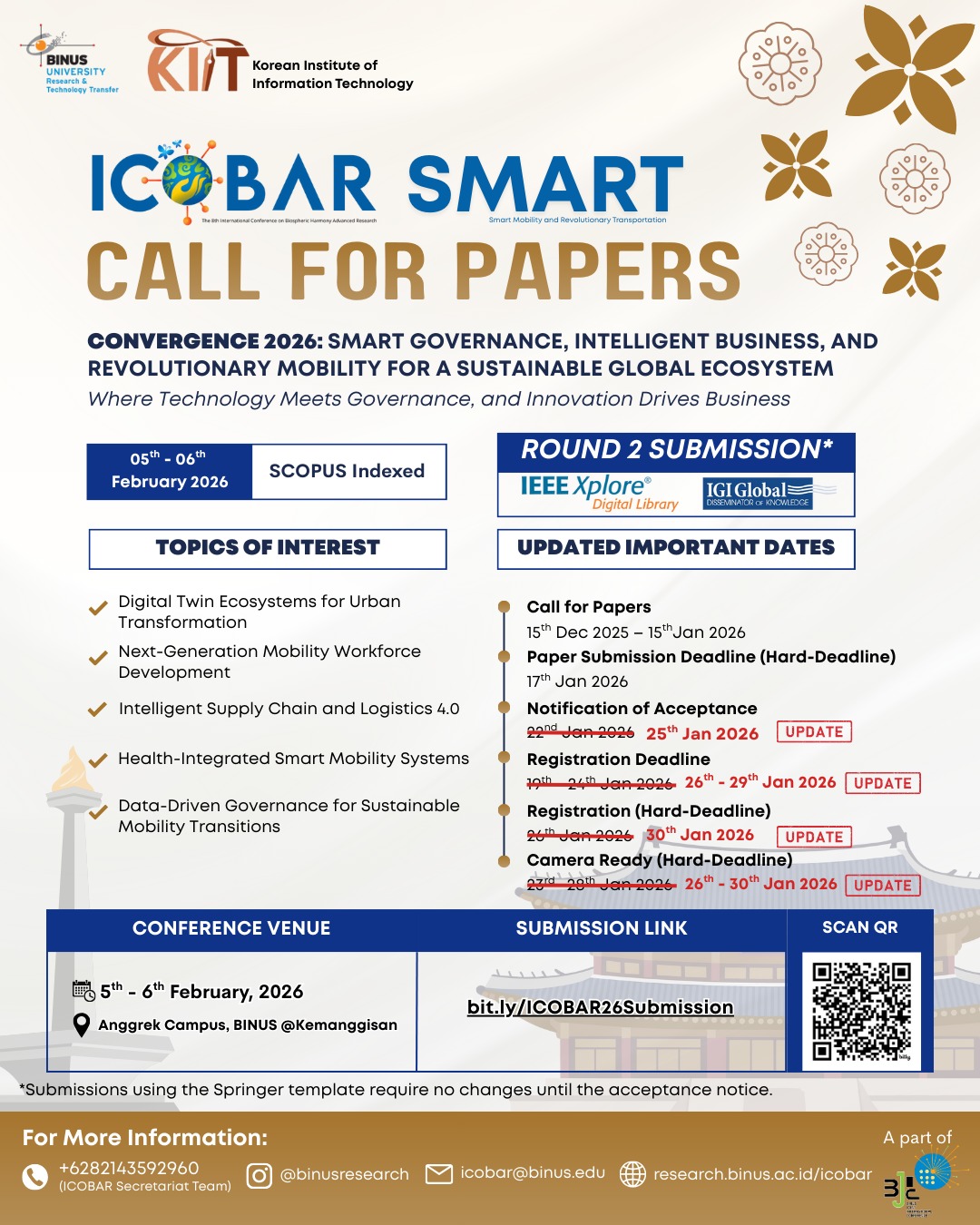
Update on Acceptance Notice
Due to an overwhelming number of high-quality submissions and to ensure a thorough and fair review by our technical program committee, we have made the decision to extend the notification date for paper acceptance. Please kindly refer to the updated dates below.
- Call for Papers: 15 Dec 2025 – 15 Jan 2026
- Paper Submission Deadline (Hard-Deadline): 17 Jan 2026
- Notification of Acceptance: 22 Jan 2026 25 Jan 2026
- Registration Window: 19 – 24 Jan 2026 26 – 29 Jan 2026
- Registration (Hard-Deadline): 26 Jan 2026 30 Jan 2026
- Camera Ready (Hard-Deadline): 23 – 28 Jan 2026 26 – 30 Jan 2026
- Conference Date: 5 – 6 February 2026.
Scope Topics and Tracks
ICOBAR-SMART 2026 welcomes submissions across the following tracks. Each track encourages interdisciplinary perspectives across Science, Technology, Education, Management, and a Multidisciplinary Science Nexus.
Track 1: Digital Twin Ecosystems for Urban Transformation
- Science: urban physics modeling; simulation of traffic-fluid dynamics; computational environmental science for pollution tracking
- Technology: IoT sensor fusion; AI-driven predictive modeling; cloud-edge architectures; AR/VR visualization tools
- Education: curriculum for digital twin literacy; professional training for planners and engineers
Management: change management for municipal digitalization; ROI frameworks; public-private partnership models - Multidisciplinary Science Nexus: urban living laboratory platforms integrating simulation data, governance workflows, citizen feedback systems, and educational modules.
Track 2: Next-Generation Mobility Workforce Development
- Science: cognitive science of human-machine interaction; learning science for technical skill acquisition
- Technology: VR/AR training simulators; AI-powered personalized learning platforms; skill-gap analytics tools
- Education: micro-credentialing; adaptive learning pathways; industry-academia co-design of curricula
- Management: talent pipeline strategies; organizational learning cultures; leadership development for digital transformation
- Multidisciplinary Science Nexus: competency frameworks combining labor market analytics, educational psychology, technology roadmaps, and organizational development strategies.
Track 3: Intelligent Supply Chain and Logistics 4.0
- Science: optimization algorithms; network theory; material science for sustainable packaging
- Technology: blockchain for transparency; autonomous drones and robots for last-mile delivery; predictive maintenance systems
- Education: digital literacy programs; executive education in logistics analytics; vocational training for automation technicians
- Management: agile governance; risk management in interconnected systems; circular economy business models
- Multidisciplinary Science Nexus: decision support systems integrating real-time logistics data, regulatory compliance, sustainability metrics, and workforce training modules.
Track 4: Health-Integrated Smart Mobility Systems
- Science: epidemiology of transport-related health impacts; ergonomics in vehicle design; air quality and public health research
- Technology: biometric monitoring in vehicles; AI for health-optimized routing; clean air filtration and monitoring systems
- Education: public health literacy campaigns; training for medical professionals on transport-related health issues
- Management: health outcome-based transport policy; insurance models for active mobility incentives; corporate wellness integration with commuting
- Multidisciplinary Science Nexus: mobility-health impact assessment platforms integrating sensors, health data analytics, policy evaluation tools, and public education campaigns.
Track 5: Data-Driven Governance for Sustainable Mobility Transitions
- Science: complex systems modeling; behavioral data analytics; policy impact simulation
- Technology: big data platforms for governance analytics; citizen engagement digital tools; open data architectures
- Education: data literacy for public administrators; evidence-based policymaking curricula; civic tech education
- Management: performance-based governance models; stakeholder engagement frameworks; adaptive policy implementation strategies
- Multidisciplinary Science Nexus: governance intelligence systems merging real-time urban data, participatory decision-making, policy simulation tools, and continuous learning feedback loops.
Conference Fee
| Type | International (USD) | National (IDR) |
| International Presenter | 200 | – |
| National Presenter | – | 3.500.000 |
| Local Presenter (BINUS) | – | 3.000.000 |
| Students Paper (BINUS) | – | 3.000.000 |
| Additional Paper (International) | 150 | – |
| Additional Paper (National) | – | 2.550.000 |
- Only one speaker is eligible to present for each paper. Additional presenter will be subject to additional presenter fee.
- Additional paper(s) refer to additional paper with the same first author.
- Conversion rate is 1 USD = Rp17.000
Venue and Hybrid Participation
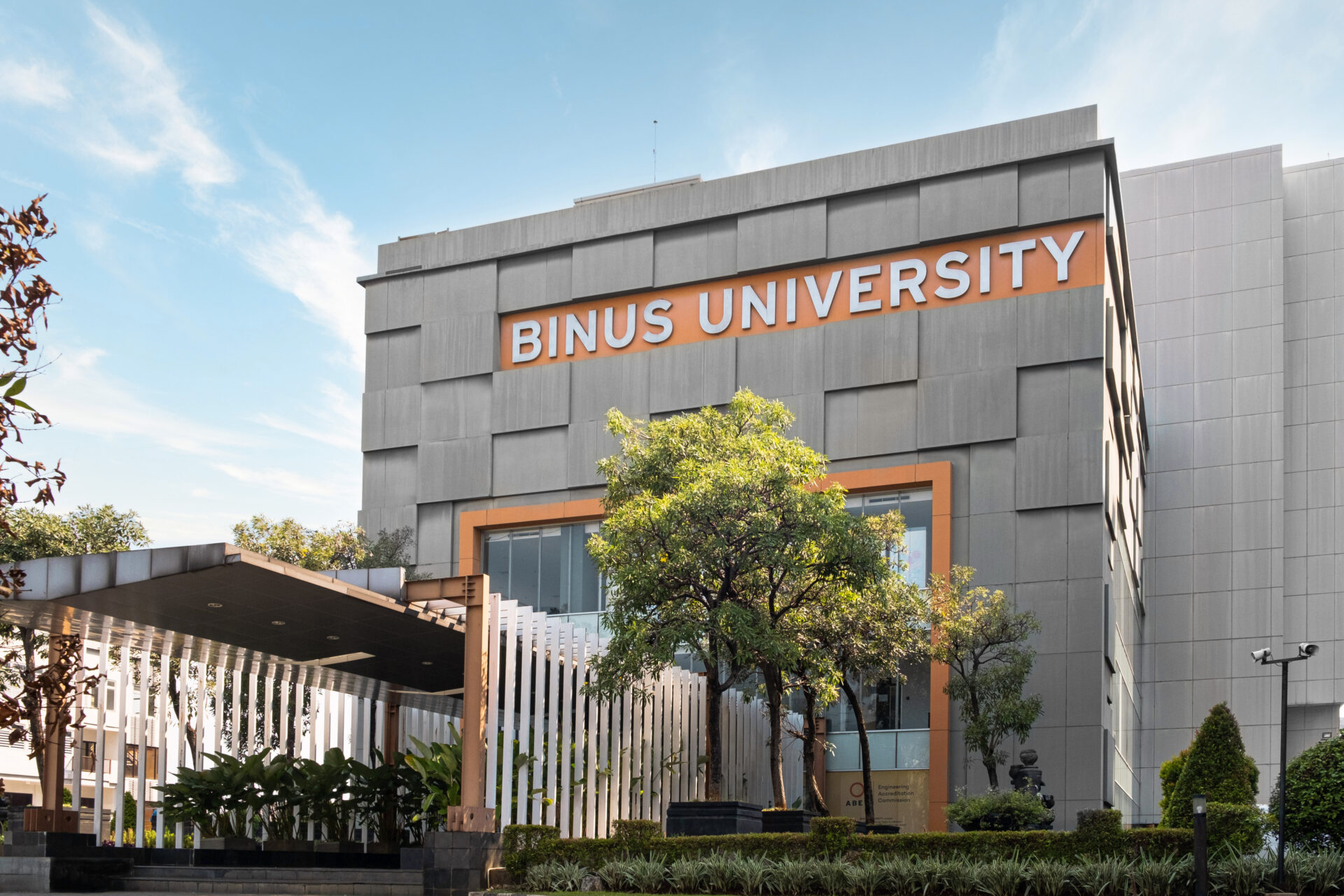
On-site venue: [8th Floor Hall, Anggrek Campus, BINUS @Kemanggisan, West Jakarta, Indonesia]
Online platform: Zoom (available only for participants who are unable to attend onsite, such as those residing outside Indonesia or with physical attendance constraints)
- Venue map: 8th Floor Hall, Anggrek Campus, BINUS @Kemanggisan LINK
- Hotel and travel info: (TBA)
- Time zone reference: UTC+7